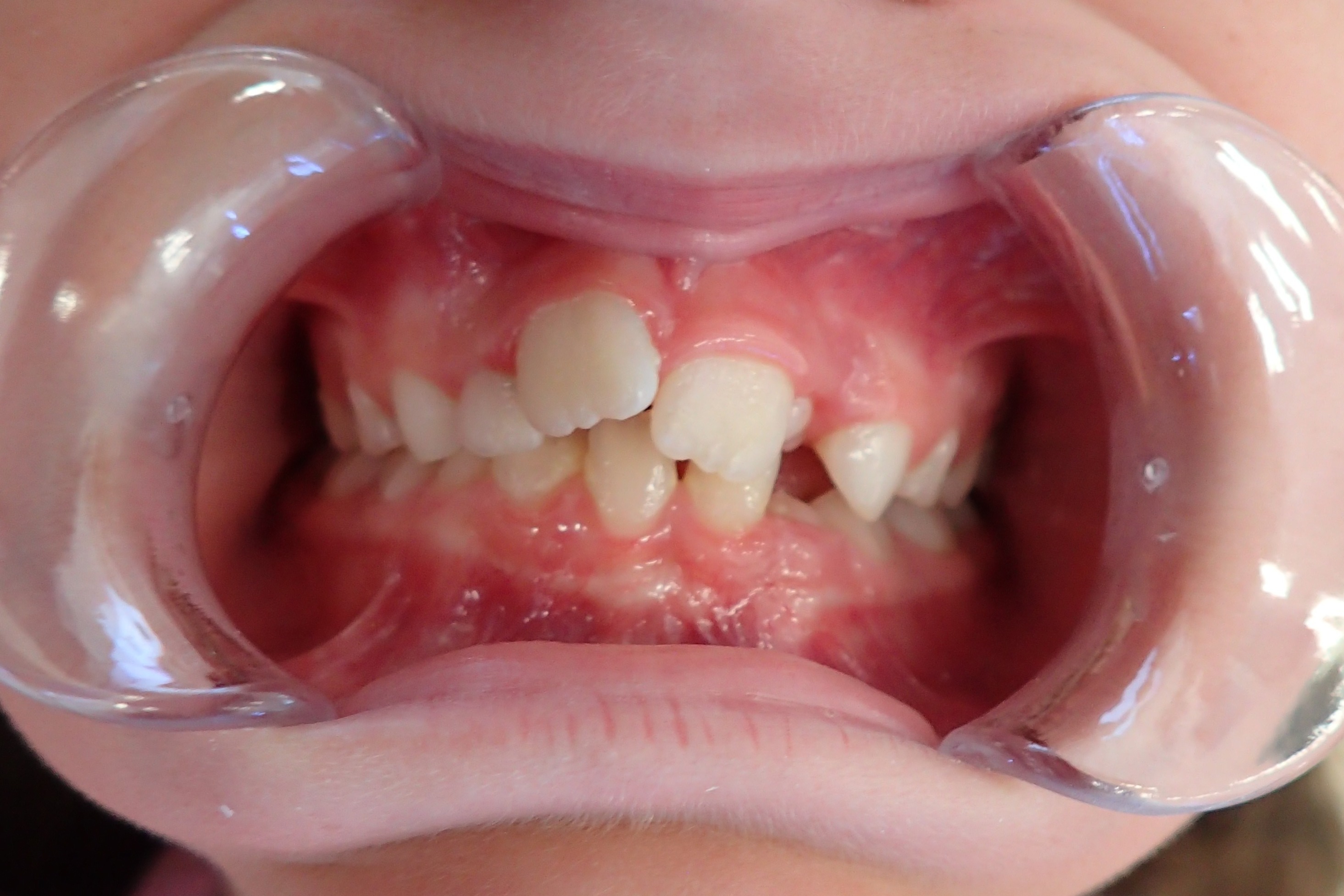
What Is Dental Crowding?
Dental crowding happens when the available space in the dental arches is smaller than the combined width of the teeth that need to fit. Teeth respond by overlapping, rotating out of their ideal positions, tipping forward or backward, or sometimes failing to erupt at all. Roughly 70% of the population has some degree of crowding, which makes it the most common finding on new-patient exams at Bold Bite Orthodontics and at orthodontic offices worldwide.
Crowding is never purely cosmetic. Overlapping teeth create crevices that a toothbrush cannot reach and floss cannot thread cleanly, so plaque accumulates in exactly the places a patient cannot clean. Over years, that plaque hardens into tartar, inflames the gums, and accelerates both cavities between the teeth and early periodontal disease. Crowded teeth also wear unevenly because the bite forces they were designed to handle land on surfaces that were never meant to carry them, which shows up as chipped edges, flattened cusps, and enamel cracks in adulthood.
Left untreated through childhood, crowding rarely resolves on its own. Mild crowding at age 9 typically becomes moderate crowding at age 15 and moderate-to-severe crowding at age 35 as the lower jaw narrows through adulthood. The cases Bold Bite sees in adult consultations are, with rare exceptions, the same cases that were present in childhood, just older and with more compensatory wear on the teeth.
Dental Crowding vs. Skeletal Crowding
Not all crowding has the same cause, and the treatment plan changes depending on which kind of crowding is driving the case. Dr. Greenberg and Dr. Cao separate crowding into two categories at the first consultation using the free 3D CBCT scan and iTero digital impression.
Dental Crowding (Tooth-Size Excess)
The teeth are larger than typical for the size of the jaw, but the jaw itself is within normal range. This is the more common pattern in adult patients and in children whose permanent teeth arrived larger than the baby teeth they replaced. Dental crowding is typically handled with space-creation inside the existing arches: interproximal reduction (IPR), limited tooth distalization to move molars back, or carefully selected enamel reshaping. Braces and clear aligners both work well.
Skeletal Crowding (Jaw Too Small or Too Narrow)
The jaw did not grow wide enough or long enough to accommodate a normal complement of teeth. This pattern shows up most clearly in the upper arch as a narrow, V-shaped palate and often appears alongside a crossbite or mouth-breathing history. Skeletal crowding responds best to palatal expansion during active growth in children, and to a combination of expansion plus arch-development mechanics in younger teens. In adults whose sutures have fused, a small selection of skeletal cases need surgically-assisted expansion (MARPE or SARPE); most adult skeletal crowding is camouflaged successfully with aligner or braces mechanics paired with careful IPR.
Why the Distinction Matters
Treating skeletal crowding as if it were purely dental is the single most common cause of relapse and extraction-first recommendations. The Bold Bite diagnostic protocol uses the Vatech Green 3D CT scan to measure the transverse width of the maxilla, the position of the mandibular condyles, the amount of buccal bone covering the roots, and the airway volume before any treatment recommendation is made. Measuring the skeleton first is what makes a non-extraction plan reliable rather than a gamble.
Severity Levels: Mild, Moderate, and Severe
Before recommending a treatment, Dr. Greenberg and Dr. Cao measure the exact amount of crowding in millimeters using digital models and 3D CBCT imaging. That measurement determines whether aligners alone will work, whether expansion is needed, or whether braces are the right first appliance.
Mild, Less Than 4 mm
One or two teeth slightly rotated or overlapping. Treatment options: clear aligners, limited braces, or interproximal reduction (IPR). 6–12 months.
Moderate, 4 to 8 mm
Two to three teeth overlap significantly. Hygiene noticeably impacted. Treatment: braces or full-arch aligners, often with IPR or palatal expansion. 12–18 months.
Severe, More Than 8 mm
Most teeth displaced, impacted canines common. Requires comprehensive braces; may include expansion or extractions. 18–24+ months.
What Causes Crowded Teeth?
Genetics
The most common single cause. A child can inherit large teeth from one parent and a smaller jaw from the other, or inherit a direct tooth-size-to-jaw-size mismatch from either side of the family. Bold Bite's case records show that more than half of pediatric crowding consultations have at least one parent who reported historic crowding of their own. Genetics is not destiny — treatment is highly effective — but recognizing the familial pattern early helps the practice monitor younger siblings before problems worsen.
Early Loss of Baby Teeth
When a baby tooth is lost prematurely to decay, trauma, or extraction, the neighboring teeth drift into the gap within weeks. By the time the permanent tooth below is ready to erupt, there is no longer room for it and the permanent tooth either tips into a crowded position or becomes impacted against the neighbor. Space maintainers, small appliances that hold the gap open until the permanent tooth arrives, can prevent the problem entirely if placed within six months of the loss. Bold Bite Orthodontics coordinates space maintainers with the child's general or pediatric dentist when early extraction has already happened.
Prolonged Thumb and Finger Habits, Tongue Thrust, Mouth Breathing
Sustained oral habits past age five alter the way the dental arches develop. A thumb habit pushes the upper teeth forward and the lower teeth back, narrows the upper arch, and routinely produces an anterior open bite along with the crowding. Chronic mouth breathing from nasal obstruction, enlarged adenoids, or untreated allergies keeps the tongue low and forward, which starves the upper palate of the outward pressure it needs to widen during growth. Bold Bite screens every pediatric consult for airway findings and coordinates with Jacksonville-area ENT and allergy specialists before starting orthodontic treatment when a habit or airway driver is present.
Late Lower Crowding in Adults
Many adults notice their lower front teeth overlapping in their late twenties and thirties even though the same teeth were straight as teenagers. The lower jaw rotates slightly forward with age while the dental arches compress inward, and the lower incisors — the narrowest teeth with the most movement available — are the first to show it. This is a normal aging pattern, not a sign of a retention failure, and it can happen to patients who never wore braces or who wore braces decades earlier. Limited aligner treatment on the lower arch with IPR is the most common Bold Bite solution for adult-onset lower crowding.
Myth: Wisdom Teeth Cause Crowding
This is one of the most repeated claims in orthodontics and one of the most thoroughly disproven. Published peer-reviewed research going back more than three decades has failed to show that erupting wisdom teeth generate enough force to crowd the front teeth. Studies that compared patients who had wisdom teeth extracted against matched patients who kept their wisdom teeth found no difference in lower incisor crowding between the two groups. Removing wisdom teeth will not straighten already-crowded front teeth, and keeping wisdom teeth will not cause straight teeth to crowd. Wisdom teeth are removed when they are impacted, carious, or at risk of infection — not as a substitute for orthodontic treatment.
Why Crowded Teeth Matter: Health Consequences
Cavities and Gum Disease
Crowded teeth create interproximal crevices that floss cannot thread cleanly and that a toothbrush cannot reach. Plaque accumulates, hardens into tartar, and inflames the gums. Patients with long-standing crowding are statistically more likely to develop periodontal disease and more likely to get cavities specifically on the surfaces where teeth overlap. Straightening the teeth restores the ability to clean them and is often the single largest oral-health intervention an adult patient receives.
Uneven Wear and Chipping
Teeth out of alignment receive bite forces they were never designed to handle. Over years, this produces visible wear facets, flattened cusps, enamel cracks, and chipped incisal edges — damage that becomes permanent without bonding, veneers, or crowns. Dr. Greenberg came from eight-plus years of general dentistry before specializing, so the Bold Bite treatment plan accounts for restorative implications from the start rather than discovering wear damage after the braces come off.
Jaw Strain and TMJ Symptoms
Crowded teeth frequently produce a compromised bite that loads the temporomandibular joint asymmetrically. Chronic jaw muscle strain, clicking, popping, and tension headaches can result, particularly in adults whose crowding has been in place for decades. Correcting the crowding is often part of the TMJ solution, though Bold Bite is careful not to promise TMJ relief from orthodontic treatment alone — splint therapy and coordination with the patient's dentist or physical therapist are often part of the plan when the joint is a primary pain driver.
Impacted Canines and Blocked-Out Teeth
When severe crowding denies a permanent canine the room it needs to erupt, the canine can become impacted inside the palate or the facial bone. Canine impaction is visible on 3D CBCT by age 10 in most cases. Bold Bite's diagnostic workflow flags at-risk canines early, handles the orthodontic side of exposure cases, and coordinates surgical exposure with Dr. Doug Stortch at Modern Perio in Jacksonville.
Confidence and Self-Image
Beyond the clinical risks, many patients report that crowding makes them self-conscious in photographs or in new-person conversations. Straightening the teeth routinely produces the single largest improvement in perceived self-confidence that orthodontic treatment delivers — particularly in adults who have lived with crowded teeth for years and did not realize how much they had been hiding their smile.
Why Early Treatment Matters for Crowding
Not every case of childhood crowding needs early treatment. The Bold Bite approach is deliberately conservative: of the hundreds of pediatric referrals the practice sees each year, roughly three out of four children are placed on a growth-monitoring recall rather than started in an appliance. Early intervention is recommended when not intervening would create a larger problem later, and not as a default.
Crowding is one of the conditions where early evaluation genuinely matters. By age 7, the American Association of Orthodontists recommends every child have a first orthodontic evaluation. At that age, the permanent first molars and lower incisors have erupted and the orthodontist can measure whether there is room for the rest of the permanent teeth to come in. When the measurement shows severe arch-length deficiency, a narrow palate, or an airway pattern that will restrict growth, the treatment window for non-extraction solutions is still open.
What early treatment for crowding can prevent
- Impaction of permanent canines (which would otherwise require surgical exposure years later)
- The need for permanent-tooth extraction during Phase 2 treatment
- Crossbites that worsen as the jaws grow asymmetrically
- Airway-restrictive palate narrowing linked to mouth breathing
- Peer-teasing and self-consciousness from visibly crooked front teeth during the middle-school years
What early treatment will not do is finish the case. A Phase 1 interceptive treatment at age 8 or 9 addresses the underlying skeletal or space-deficit issue, then the child finishes eruption over the next three to five years before returning for Phase 2 comprehensive alignment. Bold Bite explicitly frames Phase 1 that way so families understand what they are signing up for — there is no bait-and-switch from one phase to the next.
How Bold Bite Treats Crowded Teeth
| Treatment | Best For | How It Creates Space | Starting Price |
|---|---|---|---|
| Metal Braces | All severity levels | Archwire forces | $4500 |
| Clear Ceramic Braces | All levels (aesthetic preference) | Same mechanics, transparent brackets | $4700 |
| Invisalign | Mild to moderate | Sequential aligners + IPR if needed | $5,000 |
| Angel Aligners ← Lower Entry | Mild to moderate | Stiffer material for better force delivery | $4500 |
| Palatal Expansion | Children with narrow upper jaw | Widens the jaw itself (skeletal space) | $2,500–$3,000 |
| IPR | Mild-moderate (1–3 mm needed) | Gentle enamel reshaping, 0.2–0.5 mm per contact | Included with treatment |
Non-Extraction When Possible
Palatal expansion, interproximal reduction, molar distalization, and arch development can create meaningful amounts of space without removing permanent teeth. Dr. Greenberg and Dr. Cao evaluate every crowding case with 3D CBCT imaging to measure the buccal bone covering the roots, the transverse width of the maxilla, and the position of the incisors relative to the alveolar bone — the three measurements that determine whether a non-extraction plan will actually hold up long term. Permanent-tooth extraction is recommended only when the measurements show that expanding or distalizing would push roots out of bone, compromise periodontal support, or produce an unstable result that will relapse within a few years. The default is non-extraction; extraction is a considered exception, not a shortcut.
Bold Bite's Approach to Crowding
Two features separate Bold Bite's crowding workflow from a typical orthodontic office. First, every new-patient comprehensive exam includes a Vatech Green 3D CT scan and an iTero digital intraoral scan. The CBCT shows the skeletal picture — jaw width, root positions, buccal bone coverage, airway volume — in the same visit as the iTero scan, which captures the dental picture. Crowding that looks moderate in 2D photos often looks severe in the 3D measurements, and the reverse is also true. Getting both scans at the first visit is what makes the practice willing to commit to a non-extraction plan in cases where another office might recommend extraction sight unseen.
Second, every crowding patient is evaluated by both doctors before the treatment plan is finalized. Dr. Cao (DMD, CAGS — Diplomate of the American Board of Orthodontics) brings more than a decade of specialist experience and the research rigor of an ABO-Certified orthodontist. Dr. Greenberg (DMD, MS — ABO Board Eligible, clinical exam Fall 2026) brings eight-plus years as a general dentist before specializing, so the orthodontic plan always accounts for the whole-mouth restorative and periodontal context. The husband-and-wife team means two specialist perspectives on every case file — something patients would usually have to book second opinions at two separate offices to obtain.
Patients choose between braces and clear aligners for the same reasons they would at any office — aesthetics, removability, treatment length, and cost. Bold Bite does not push one appliance over the other for crowding. Angel Aligners is the primary aligner platform, Invisalign remains available for families who prefer it, and braces remain the first-line choice for severe crowding, heavy rotations, and hygiene-compromised cases. Patients who start in aligners and later prefer braces can switch mid-treatment for a $400 fee — a safety net most offices do not offer.
Phase 1 (Interceptive) Treatment for Crowded Baby Teeth
Phase 1 treatment for crowding is typically recommended at Bold Bite around age 8 or 9, once enough permanent teeth have erupted for the orthodontist to measure the space deficiency with confidence. Phase 1 is interceptive — the goal is to correct the underlying space or skeletal problem now so that Phase 2 comprehensive alignment can be simpler, shorter, and non-extraction when the time comes.
Common Phase 1 Appliances for Crowding
- Palatal expander — widens a narrow upper jaw so permanent teeth have room to erupt without crowding. Ideal patient age: 7 to 12 while the midpalatal suture is still open. Typical in-office time is 6 to 9 months of active expansion followed by a holding period.
- Space maintainer — preserves a gap where a baby tooth has been lost prematurely, so the permanent tooth below has room to erupt straight.
- Limited braces on the upper front teeth (2x4 or 2x6) — aligns erupting permanent incisors when they are coming in severely crowded or rotated and risk damaging neighboring teeth.
- Nance or lingual arch holding appliance — holds molar position when natural baby-tooth spacing would otherwise close prematurely.
Phase 1 at Bold Bite typically runs 12 to 18 months of active treatment, followed by a monitoring period during which the child is seen every six months at no additional cost while the remaining permanent teeth erupt. Phase 2 — the comprehensive alignment phase — then takes place in the early-to-middle teens, typically with a shorter timeline and less complexity than the same case would have required without Phase 1.
Not every child with crowding needs Phase 1. Mild crowding that the orthodontist can reasonably expect growth to resolve is watched, not treated. The conservative Bold Bite posture means families should expect a recommendation to monitor on most pediatric consultations — and when Phase 1 is recommended, the reasoning is explained in plain language with the 3D scans on screen.
Typical Treatment Timeline
The timeline below is a realistic range based on crowding severity. Every case is individual; Dr. Greenberg and Dr. Cao confirm exact timing after digital records at the consultation.
| Severity | Braces Timeline | Aligners Timeline | Visits |
|---|---|---|---|
| Mild (<4 mm) | 6–12 months | 6–12 months | Every 6–10 weeks |
| Moderate (4–8 mm) | 12–18 months | 12–18 months | Every 6–10 weeks |
| Severe (>8 mm) | 18–24+ months | Often not suitable | Every 6–8 weeks |
How Long Should Crowding Treatment Really Take?
Realistic crowding timelines at Bold Bite depend on three factors: the severity of the crowding in millimeters, whether expansion or other space-creation mechanics are part of the plan, and the patient's biological response to tooth movement. Phase 1 interceptive treatment typically runs 12 to 18 months. Comprehensive Phase 2 or adult treatment runs 18 to 24 months for moderate crowding, longer for severe cases involving expansion or extractions. Limited treatment — minor adult crowding on a single arch — can finish in as few as six months on aligners. Surgical orthodontic cases that include crowding correction typically run 30 months including the pre- and post-surgical orthodontic phases. Every estimate is case-specific, not a fixed protocol, and Bold Bite confirms the timeline in writing at the consultation after the 3D scans rather than quoting a generic range by phone.
What to Expect at a Bold Bite Crowding Consultation
- Digital intake (about 10 minutes). Medical and dental history, the specific concerns the family has noticed, and goals for treatment.
- Comprehensive records. Digital iTero and Allied Star scan of the teeth, free 3D CBCT for crowding severity, root positions, and impaction risk, and clinical photos.
- Diagnosis with Dr. Greenberg or Dr. Cao. The doctor walks the patient or parent through the images on-screen and explains what the scans show in plain language, millimeters of crowding measured, which permanent teeth are erupting, and whether the jaw has room.
- Every appropriate treatment option. Families receive each option Bold Bite Orthodontics considers appropriate for the case, not a single take-it-or-leave-it recommendation, so speed, aesthetics, and cost can be weighed together.
- Exact itemized pricing. A written quote with the insurance estimate, financing options, and any discounts the family qualifies for. No same-day contract is required.
The consultation is free, and there is no obligation to start treatment at Bold Bite. Families across Jacksonville and the surrounding communities leave the first visit knowing the severity of the crowding, the full list of options, and what each will cost.
Before & After
More crowding cases are in the Bold Bite treated cases gallery, with severity level, treatment type, and timeline noted for each.
How Much Does It Cost to Fix Crowded Teeth at Bold Bite?
Metal braces: from $4500 (comprehensive)
Clear ceramic braces: from $4700 (comprehensive)
Angel Aligners: from $4500 (comprehensive) ← Lower Entry
Invisalign: from $5,000 (comprehensive)
Phase 1 (early treatment): Braces from $4000 · Angel from $4500 · Invisalign from $4500 · Palatal expander $2,500–$3,000
Financing at Bold Bite
In-house 0% APR: 0% interest, no credit check, and down-payment amount set by the treatment type and insurance benefit. Monthly payments on the in-house plan start at $150 per month and run month-to-month for the length of active treatment. Cherry: soft-credit-check financing with flexible terms and a Varies typical down payment — useful for families who need a longer payoff window than the in-house plan offers. Pay in Full: a 3% discount off the total treatment fee for families who pay up front. Insurance covers a portion of treatment for most PPO plans; Bold Bite verifies benefits before the consultation and applies the estimated benefit to the itemized quote. Community discounts apply to military families, teachers, public-safety personnel, and sibling cases.
Common Appliances Used at Bold Bite
Frequently Asked Questions About Crowded Teeth
Can crowded teeth be fixed without braces?
For mild crowding (less than 4 mm), clear aligners like Invisalign or Angel Aligners can effectively straighten teeth. Moderate crowding may work with aligners plus IPR or attachments. Severe crowding almost always requires braces.
Do wisdom teeth cause crowding?
No. Research has shown wisdom teeth do not generate enough force to push front teeth into crowded positions. Late crowding happens naturally as the jaw narrows throughout adulthood, regardless of whether wisdom teeth are present.
How long does it take to fix crowded teeth?
Mild: 6–12 months. Moderate: 12–18 months. Severe: 18–24+ months.
Will crowded teeth get worse over time?
Yes. Crowding tends to worsen with age. The lower front teeth are especially prone to late crowding, even in adults who had straight teeth as teenagers. Without treatment, crowding increases the risk of cavities, gum disease, and abnormal wear.
Can children get early treatment for crowding?
Yes. By age 7, an orthodontist can identify whether the jaw is too narrow for incoming permanent teeth. Palatal expansion can create space for crowded teeth to erupt properly, often avoiding extractions later. Phase 1 treatment typically takes 6–12 months.
Do I need extractions?
Usually no. Bold Bite Orthodontics practices a non-extraction philosophy whenever possible, using expansion, IPR, and arch development to create space. Extractions are reserved for cases where non-extraction would compromise periodontal health or long-term stability.
Is treatment more painful with severe crowding?
No. Modern light-force mechanics produce mild soreness for 3–5 days after adjustments regardless of severity.
Related Conditions
Ready to Fix Your Crowded Teeth?
Free consultation includes a CBCT scan, severity assessment, and a clear treatment recommendation with options and pricing. No obligation. Community discounts apply.
Schedule Free Consultation